Wareham Spillway Replacement Project
blasting notice:
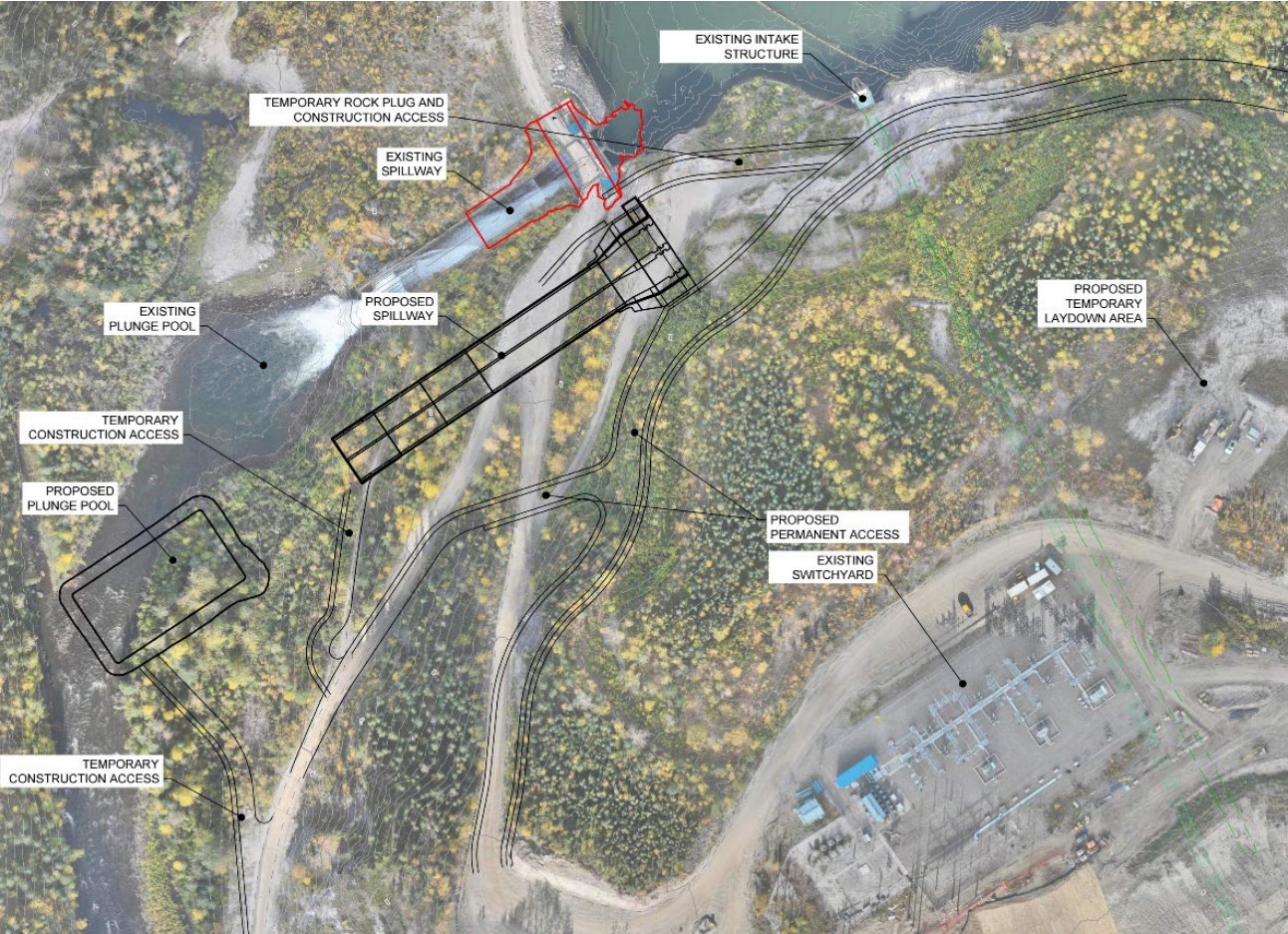
Some of the work at the Wareham Dam will include controlled blasting for the access road and new spillway channel. Kiewit has detailed blasting plans in place, and the work will be managed with public safety in mind. Blasting will occur daily at regular intervals over a 24-hour period, including overnight. The blasting will continue until October 2026. An example of a blast is available here. Questions can be directed to Mayo.Spillway@kiewit.com.
What is the Wareham spillway?
The Wareham dam and spillway make up part of the Mayo Hydro Facility and were commissioned in 1952. Just upstream of Wareham dam, water enters an underground pipe that goes to the Mayo A and Mayo B generators to make electricity. When there is too much water to use, it flows down the spillway and back into the Mayo River.
What's happening?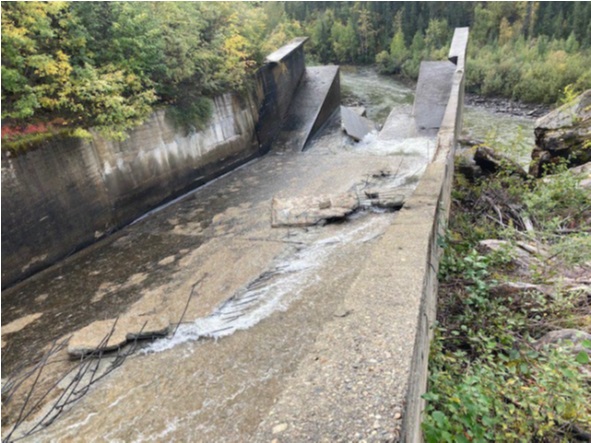
We conduct regular dam safety inspections. After one of these inspections, we noticed there was damage to the concrete on the base of the spillway after high water levels in 2020. We completed life-extending repairs to the structure in 2021 and 2022 but, in December 2023, an engineering assessment found that the spillway had deteriorated beyond the point of repair, and that the spillway needed to be replaced. Since the 2023 engineering assessment, two other independent engineering assessments have confirmed that the spillway requires urgent replacement.
What has Yukon Energy been doing since it found out the spillway needed to be replaced?
In 2023, after finding out the spillway needed to be replaced, we immediately started planning and designing for the new spillway. This included looking at 8 potential replacement options, which has since been narrowed down to an open channel design. As part of this process, we sought input from a construction contractor and the First Nation of Na-cho Nyäk Dun (FNNND). We are currently working closely with a contractor to advance the proposed open channel solution, progressing the design under a progressive design-build model. We also continue to carry out work on the existing spillway, including inspections and interim repairs, to ensure safe operations until the permanent solution is implemented.
Why did you select an open channel design for the spillway replacement?
The open channel option provides greater cost certainty and can be built quicker. It avoids the risks that come with tunnelling through rock, and it requires less complex excavation work. Most importantly, it can be built in a way that helps manage high spring water flows sooner. This means that, even before the project is finished, it can help safely pass water during freshet in 2027 and 2028.
Should I be worried about flooding or my personal safety?
No. While risks to public safety are increased with the spillway in its current condition, and will increase if this work is delayed, Yukon Energy has implemented an intensified surveillance, monitoring and maintenance program to maintain operation of the existing spillway, which would alert Yukon Energy staff of any issues before they occurred. In the event of an incident, Yukon Energy would work with the Yukon government’s Emergency Measures Organization to alert the First Nation of Na-Cho Nyäk Dun, Village of Mayo and the community.
What is Yukon Energy doing to prepare for a potential emergency?
Yukon Energy completes regular inspections of the spillway, ranging from daily site checks to annual engineering reviews by its own dam safety engineer and external experts. We also monitor key instruments monthly to detect any early warning signs. In addition, Yukon Energy's contractor that is currently working on the rock slope at the hydro facility keeps equipment on site that can be used quickly if a rapid response is ever needed.
Yukon Energy has also updated its Emergency Preparedness Plan for the Mayo Hydro Facility. In May of 2025, we participated in a tabletop exercise led by the Government of Yukon's Emergency Measures Organization where we walked through the steps all parties would take in the event that the spillway or dam failed and fast flowing water started to move towards Mayo. Planning for these types of situations is normal for hydro utilities like Yukon Energy.
Will Yukon Energy be considering fish passage in the spillway reconstruction?
Yukon Energy recognizes the First Nation of Na-Cho Nyäk Dun (FNNND)'s strong interest in upstream fish passage at the Wareham dam. The open channel configuration for the new spillway incorporates several specific design features intended to improve downstream fish passage. These include increasing water depth within the open channel spillway using a wall separating the two chute bays, optimizing the chute floor geometry to provide improved conditions for fish passage while in the chute, designing the downstream end of the spillway (final option to be confirmed) to safely convey fish into the plunge pool, along with construction of a new plunge pool. Survival for fish passing the new spillway is expected to be improved (potentially greater than 90%) and will be confirmed via performance testing post-construction. While Yukon Energy has no regulatory obligation to install upstream fish passage, we are working with technical specialists and engaging with the FNNND on potential options. No aspect of the proposed spillway replacement would prohibit future provision of fish passage upstream of the dam and spillway.
How much will the project cost?
The project is expected to cost around $180 million. Yukon Energy continues to seek government funding to reduce the impact on ratepayers.
What are the next steps?
Yukon Energy submitted a Project Proposal to the Yukon Environmental and Socio-economic Assessment Board (YESAB) in March 2026. The full Project Proposal is available here. Construction is expected to begin in June of 2026 and be completed in 2028.
Work at the spillway this year will include (pending necessary regulatory approvals):
- site preparation and access improvements;
- excavation, drilling/blasting, rock removal and hauling for new spillway footprint;
- installation of foundations and structural supports; and
- preparation for major concrete work in 2027.